


What is indoor air quality and why does it matter for buildings?
14 January 2026
Key points
- Indoor air quality (IAQ) describes the chemical, particulate, biological and physical characteristics of the air inside a building.
- Typical indoor pollutants include fine particles, volatile organic compounds (VOCs), combustion gases and bioaerosols such as bacteria and mould spores.
- IAQ affects comfort, perceived freshness of spaces, ability to concentrate, and how well ventilation and air cleaning systems are performing.
- Good IAQ is the result of several elements working together: source control, ventilation, filtration and, where needed, additional air cleaning.
- Real building data show that targeted air purification can significantly reduce particles, VOCs and microbes in occupied spaces, and can support more efficient building operation.
When people ask “what is indoor air quality and why does it matter for buildings?”, they are really asking how the air inside a space is defined and controlled.
Indoor air quality has moved from being a niche topic to a core part of building design and operation.
It is now discussed in the same breath as thermal comfort, energy use and acoustics.
This article explains what “indoor air quality” actually means, which pollutants are involved, how IAQ is measured in practice, and why it matters for building owners, operators and occupants.
What is indoor air quality (IAQ)?
Indoor air quality is a broad term. It covers several aspects of the air inside a room or building:
- Chemical composition – levels of gases such as carbon dioxide (CO₂), nitrogen dioxide (NO₂), ozone (O₃) and a wide range of VOCs.
- Particles – suspended solid and liquid particles, from coarse dust to fine particulate matter such as PM₂.₅.
- Biological content – airborne bacteria, viruses, mould spores and fragments of biological origin (sometimes called bioaerosols).
- Physical conditions – temperature, relative humidity and air movement.
The standard for IAQ should be that:
- Concentrations of pollutants are kept low and stable.
- Conditions are within ranges that are comfortable and acceptable for the intended use of the space.
- The systems that influence IAQ (ventilation, filtration, air cleaning, controls) are working as intended.
The key point is that we can measure IAQ following a set of parameters tracked over time.
Which pollutants are typically found indoors?
Most buildings contain a mixture of pollutants from both indoor and outdoor sources. The main groups are:
Particulate matter
- PM₁₀ (particles up to 10 micrometres) – often associated with coarse dust and larger droplets.
- PM₂.₅ (particles up to 2.5 micrometres) – fine particles that stay airborne for long periods and can penetrate deep into the lungs, entering the bloodstream and circulating round the body to additional organs.
- Ultrafine particles – below 0.1 micrometres, often from combustion or high-temperature processes.
Sources include outdoor traffic and combustion, resuspension of settled dust by movement, printers, cooking, and some mechanical processes.
Volatile organic compounds (VOCs)
VOCs are a large family of carbon-based chemicals that can evaporate at room temperature. Common indoor sources include:
- Paints, varnishes and adhesives
- Furniture, carpets and other building materials
- Cleaning products and disinfectants
- Office equipment and some consumer products
Total VOC (TVOC) is often used as a simple indicator of the overall VOC load.
Combustion gases and other inorganic gases
Important examples include:
- Carbon dioxide (CO₂) – mainly from human breathing, used as an indicator of occupancy and ventilation effectiveness.
- Nitrogen dioxide (NO₂) – from outdoor traffic, gas appliances and other combustion.
- Carbon monoxide (CO) – from incomplete combustion; a safety concern at elevated levels.
- Ozone (O₃) – mostly from outdoors, but can also be produced indoors by some devices and processes.
Bioaerosols
Bioaerosols include:
- Bacteria
- Viruses
- Fungal spores and fragments (e.g. mould)
- Pollen and other biological fragments
They can originate from occupants, outdoor air, damp building elements and surfaces.
In practice, each building has its own “fingerprint” of pollutants, driven by use, occupancy, outdoor environment and the systems installed.
How is indoor air quality measured in practice?
There is no single number that summarises IAQ. Instead, buildings monitor a set of indicators.
Commonly measured parameters include:
- CO₂ (ppm) – often used as a proxy for ventilation rate per person.
- PM₂.₅ and PM₁₀ (µg/m³) – measured with particulate sensors.
- TVOC (µg/m³ or ppb) – measured with gas sensors.
- Temperature and relative humidity – as part of comfort and mould risk assessment.
Microbial measurements (bacteria, fungi, sometimes viruses) are typically done via:
- Active air sampling onto culture plates
- Surface swabs
- More advanced molecular techniques in research settings
These methods are usually used for periodic assessments rather than continuous monitoring, because they are more complex and slower than electronic sensing.
In Healthy Air case studies, combinations of these approaches have been used. For example:
- Office and co-working studies have tracked PM₂.₅, PM₁₀ and TVOCs before, during and after operating air purification units, showing significant reductions when devices are in use and a rise back towards baseline when they are turned off.
- Medical practice and dental clinic studies have used microbiological air sampling to track changes in airborne bacteria and moulds over days of operation.
Together, these methods give a more complete picture of IAQ in real spaces.
Why does indoor air quality matter for building performance?
Indoor air quality affects more than just whether a room feels “fresh”.
Comfort and perceived quality of space
Occupants are sensitive to stuffy or stale air, noticeable odours and visible dust.
Even without referring to medical outcomes, these factors directly influence how people feel about spending time in a building.
Ability to concentrate and perform tasks
Research has shown links between ventilation rates, pollutant levels and cognitive performance or self-reported ability to concentrate. At a practical level:
- High CO₂ and poor ventilation are often associated with people feeling drowsy and less alert.
- Dusty or odorous environments can be distracting and reduce perceived productivity.
For organisations, this translates into how effectively people can work, learn or recover in the building.
Operational risk, compliance and reputation
Poor IAQ can be associated with:
- Difficulty meeting internal policies or external guidelines.
- Visits from regulators or clients that highlight poor environmental conditions.
- Reputational issues, especially in sectors that are expected to be clinically clean or high-performance (healthcare, laboratories, elite sport, high-end offices).
By contrast, being able to measure and demonstrate good IAQ is increasingly seen as part of professional building management.
For a UK building-services perspective, the Building Engineering Services Association’s (BESA) Indoor Air Quality focus area explains why IAQ and ventilation are now central to building performance.
For a broader overview of why indoor air quality matters, see our article “Why Clean Indoor Air Matters More Than Ever And How to Achieve It.”
Interaction with energy and net-zero goals
Ventilation, filtration and air cleaning all influence energy use. For example:
- Increased outdoor air ventilation improves IAQ but increases heating and cooling loads.
- Recirculated air with effective filtration and cleaning can help maintain IAQ while controlling energy use.
In a zero-carbon smart home project, the combination of targeted air purification, careful airflow design and smart control contributed to measurable energy savings while maintaining comfort and air quality. IAQ and energy performance must be considered together, not in isolation.
How do ventilation and air cleaning work together?
Good IAQ usually depends on several controls acting together, rather than one “magic” solution.
Source control
The first step is to reduce pollutants at source where possible:
- Selecting low-emission materials and products
- Managing activities that generate dust or fumes
- Addressing damp and water ingress
This reduces the burden on ventilation and air cleaning systems.
Ventilation
Ventilation dilutes indoor pollutants by bringing in outdoor air and exhausting indoor air. It can be provided by:
- Mechanical systems (fans, ducts, heat recovery units)
- Natural ventilation (windows, vents)
- Hybrid systems
Ventilation is essential, but on its own it may not be sufficient, especially when outdoor air is polluted (e.g. traffic, smoke), the building is highly occupied and/or there are strong indoor sources of pollutants.
Filtration and air cleaning
Filtration and air cleaning complement ventilation by removing pollutants from air that is already indoors.
Technologies include:
- Mechanical filters (e.g. HEPA) for particles
- Activated carbon and other sorbents for VOCs
- Catalytic systems (such as D-orbital nano oxide catalysts) that break down gases and bioaerosols at a solid surface
In practice, effective IAQ management means choosing and combining these elements in a way that fits the building’s use, constraints and targets.
What have real buildings shown when IAQ is improved?
Several Healthy Air deployments in real buildings provide concrete examples of how IAQ can change:
- Offices and engineering workplaces
- Independent studies have shown notable reductions in PM₂.₅, PM₁₀ and TVOCs when air purification units are operating, with levels rising again when devices are switched off.
- This shows that the devices are acting as a net sink for particles and VOCs in normal use, rather than a source of new pollutants.
- Medical and dental practices
- Microbiological sampling before and during operation of air purifiers has shown substantial reductions in airborne bacteria in treatment rooms and nearby corridors, without additional chemical sprays.
- When devices are removed, microbial levels tend to move back towards baseline.
- Hospitals and healthcare facilities
- Air cleaners have been used to support existing HVAC and infection-control strategies, especially in areas where upgrading ducted systems is difficult or where additional local control is desired.
- Residential and specialist environments
- In homes with vulnerable occupants, portable units have been used as part of a broader environmental strategy to keep dust, particles and odours under better control, alongside normal ventilation and cleaning.
These examples show that IAQ is not an abstract concept. It can be measured, influenced and tracked in the same way as temperature or energy use.
What practical steps can building owners take?
The following checklist summarises practical actions that follow from understanding IAQ:
- Identify your key IAQ concerns
- High occupancy, nearby traffic, specific odours, moisture problems, sensitive activities or occupants.
- Measure the basics
- Start with CO₂, PM₂.₅/PM₁₀, temperature and relative humidity.
- Add TVOC monitoring and periodic microbial sampling where appropriate.
- Review sources and ventilation
- Reduce known pollutant sources where feasible.
- Check that ventilation systems are delivering intended outdoor air rates and are maintained.
- Evaluate filtration and air cleaning options
- Look at existing filtration in HVAC systems (filter class, condition, change intervals).
- Consider local air cleaning units for critical or hard-to-ventilate spaces.
- Examine independent test data, paying attention to both pollutant removal and absence of harmful by-products.
- Integrate IAQ into building management
- Include IAQ indicators in dashboards and reporting.
- Track trends over time and correlate with complaints, usage patterns or events.
- Factor IAQ into refurbishment, fit-out and energy projects.
Ultimately, indoor air quality is a core performance attribute of a building. Treating it as such – with clear definitions, measurements and control strategies – helps create spaces that are more comfortable, more robust and easier to manage over the long term.
Photo by Max Vakhtbovycn from Pexels: https://www.pexels.com/photo/spacious-conference-room-with-glass-doors-7511753/
Latest News
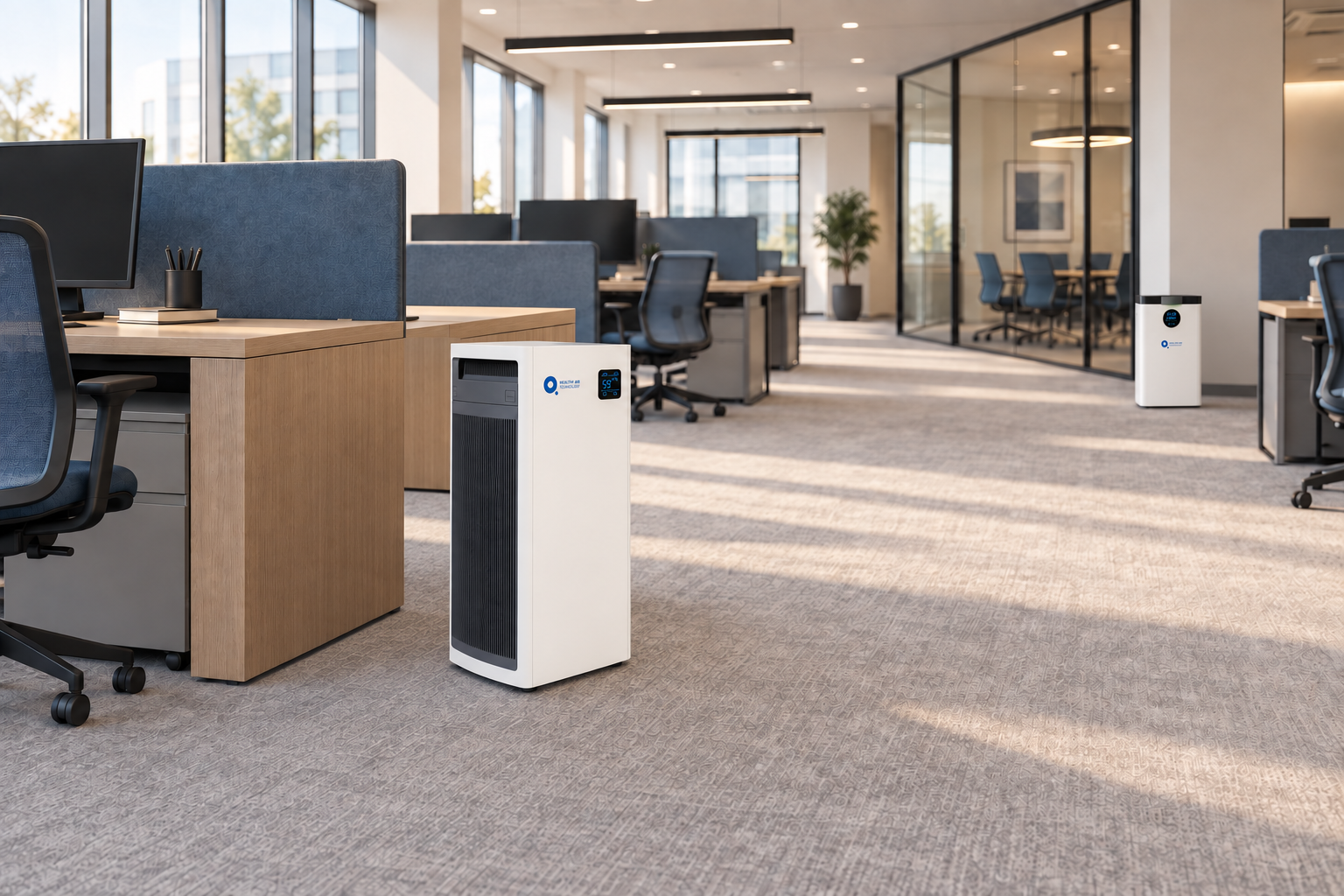
How can air purification improve air quality in offices and co-working spaces?
Key points Offices and co-working spaces often contain a mixed pollutant profile: outdoor particles, indoor dust, VOCs, bioaerosols,…
What a UK study reveals about indoor air triggers in asthma and COPD
Dust, smoke, cooking particles, fragrances, and mould were among the everyday indoor-air concerns identified by people with asthma and…

How can schools, universities and training centres use air cleaning effectively?
Key points Air cleaning can help reduce airborne particles in classrooms, lecture rooms, libraries, training rooms and shared…