


How do different indoor air purification technologies actually work?
4 February 2026
Key points
-
“Air purification” is not one technology: different systems target particles, gases/VOCs, and bioaerosols in different ways.
-
Mechanical filtration (e.g. HEPA) is strong for particles, but needs complementary methods for many gases and odours.
-
Adsorbents (e.g. activated carbon) can capture gases/VOCs, but they can saturate and need replacement or regeneration.
-
Some “active” technologies (UV/PCO, plasma/ionisers, ozone-based approaches) can create secondary air pollution if reactions are not controlled.
-
Catalytic oxidation systems aim to keep reactive chemistry confined to a surface and convert pollutants to stable end products.
Indoor air cleaning is often discussed as if all purifiers do the same job. In reality, different indoor air purification technologies work in fundamentally different ways, and they do not all remove the same pollutants.
This article explains the main technology families you will encounter—how they work, what they tend to be good at, and what their practical limitations are. If you want background on pollutant types, it helps to read Article 2: Indoor air pollutants in modern buildings first. If you want the risk concept used throughout this article, see Article 3: Secondary air pollution.
What problems are indoor air purification technologies trying to solve?
Most systems aim to reduce one or more of the following:
-
Particles
Examples: PM₂.₅, PM₁₀, dust, smoke, droplets and some allergen particles. -
Gases and VOCs
Examples: solvent vapours, formaldehyde, odours, NO₂, SO₂, ozone, and other reactive gases. -
Bioaerosols
Examples: bacteria, mould spores, and virus-containing aerosols.
The important point is that a device can be excellent at one category and mediocre at another. When a product claims “removes pollutants,” the first technical question should be: which pollutants, and by what mechanism?
Which indoor air purification technologies are most common?
Most real-world devices use one or more of these families:
-
Mechanical filtration (pre-filters, HEPA, high-MERV media)
-
Adsorption (activated carbon, other sorbents)
-
UV-based disinfection (UV-C / germicidal UV)
-
Photocatalytic oxidation (PCO) (UV + catalyst)
-
Ionisers / electrostatic / plasma approaches
-
Ozone-generating methods (rarely appropriate for occupied spaces)
-
Catalytic oxidation (surface-confined chemistry; often paired with filtration)
The sections below explain these in practical terms.
How does mechanical filtration work?
Mechanical filters remove particles by forcing air through a fibrous or porous medium. Particles are captured by a combination of mechanisms:
-
Sieving/interception (larger particles collide with fibres)
-
Inertial impaction (particles cannot follow airflow around fibres)
-
Diffusion (very small particles wander via Brownian motion and hit fibres)
-
Electrostatic effects (in some filter media)
What mechanical filtration is good at
-
Fine particles such as PM₂.₅, smoke, and many airborne droplets
-
General visible dust reduction
-
Supporting a stable baseline for indoor particle levels when run continuously
What to watch
-
Filtration does not automatically solve gases/VOCs (that requires adsorption or chemistry)
-
Filters load over time: pressure drop increases, and performance depends on maintenance
-
If captured biological material is not inactivated, systems can raise questions about secondary release during handling or as the filter ages (see Article 3)
In short: filtration is often the backbone of particle control, but it is not a complete solution for gases.
How does activated carbon and adsorption work?
Adsorbents remove gases by binding molecules onto a high surface area material. Activated carbon is common; other media (including treated carbons or mineral sorbents) can be used for specific gases.
What adsorption is good at
-
Many odours and VOCs, depending on chemical type and carbon formulation
-
Complementing HEPA, because HEPA does little for gases
What to watch
-
Adsorbents saturate (they fill up). Performance can drop quietly over time.
-
Some captured compounds can desorb (come back off) if conditions change (temperature, humidity, concentration gradients), which is one way “secondary release” can occur for gases.
-
“Carbon included” is not enough information: quantity and formulation matter, but these are not always clearly reported.
A practical mindset is: adsorption can be very useful, but it is a capacity-limited approach that depends on correct sizing and replacement intervals.
How does UV disinfection work?
UV-C (germicidal UV) can inactivate microorganisms by damaging nucleic acids. In air systems, it is typically used in one of two ways:
-
In-duct UV (treats air passing through HVAC ductwork)
-
In-device UV chamber (treats air inside a purifier housing)
What UV can be good at
-
Reducing viable microbes when exposure is sufficient (intensity × time)
-
Treating surfaces in HVAC (e.g. coils, drain pans) as well as air
What to watch
-
UV is a “dose” technology: effectiveness depends on airflow rate, lamp intensity, geometry, and maintenance
-
UV by itself does not remove gases/VOCs
-
Some UV systems, depending on wavelength and design, may contribute to unwanted by-products (the details vary by implementation)
UV tends to work best when the air is forced through a controlled irradiation zone, rather than relying on line-of-sight exposure in a room.
How does photocatalytic oxidation (PCO) work?
PCO uses a catalyst (often titanium dioxide) illuminated by UV to generate reactive species at the catalyst surface. In principle, those reactive species oxidise VOCs and other pollutants.
What PCO aims to do
-
Oxidise VOCs and some odorous compounds
-
Contribute to microbial inactivation at surfaces
What to watch
PCO is where “secondary air pollution” becomes a central concept. If oxidation is incomplete or reactive intermediates escape the catalyst surface, the system can generate trace by-products (including partially oxidised VOC fragments). In other words, the mechanism that breaks molecules can also create new ones if it is not fully controlled (see Article 3 for the definition and why it matters).
Because real indoor air is a complex mix of VOCs, humidity and particles, PCO performance can be difficult to generalise from simple lab demonstrations.
How do ionisers, electrostatic precipitators, and plasma systems work?
These technologies use electrical fields to charge particles and/or generate reactive species:
-
Ionisers charge airborne particles so they cluster or deposit on surfaces
-
Electrostatic precipitators charge and capture particles on collector plates
-
Non-thermal plasma creates a reactive environment that can oxidise pollutants and inactivate microbes
What they can be good at
-
Particle reduction in certain engineered designs
-
Some microbial and odour effects (highly dependent on configuration)
What to watch
A recurring concern is by-product formation, especially ozone and other reactive species, depending on the design and settings. This is not an abstract issue: the same reactive chemistry that helps with oxidation can also produce indoor oxidants or reaction products if not tightly contained.
If a device uses ionisation or plasma, it is reasonable to ask what the measured ozone emission is under the exact operating mode intended for occupied rooms.
Why are ozone-generating methods usually treated differently?
Ozone is a strong oxidant. Some systems deliberately generate ozone to react with odours or microorganisms. The problem is that ozone can also react with indoor VOC mixtures to form secondary pollutants and can be undesirable in occupied air.
For most occupied-building contexts, technologies that rely on ozone as a primary mechanism require careful justification and control.
How does catalytic oxidation differ from “bulk air” oxidation?
Catalytic oxidation aims to keep the reactive chemistry on a solid surface, rather than releasing oxidants into the room air.
In a surface-confined approach:
-
Pollutants contact the catalyst surface (often assisted by adsorption)
-
Reactive oxygen species form at the surface
-
Pollutants oxidise toward stable end products at or near that surface
-
The system avoids relying on free oxidants (like ozone) circulating in the occupied space
This “confine the chemistry” design principle is one route to lowering the risk of secondary by-products compared with approaches that generate reactive species in the bulk air.
If you are comparing systems and want a useful question to ask:
Does the device create reactive chemistry in the room air, or mostly within a contained surface/duct/chamber?
Why do many devices combine technologies?
Because indoor air is a mixture of pollutant types, many practical systems combine mechanisms, for example:
-
Pre-filter + HEPA for particles
-
Carbon/sorbent for odours and VOCs
-
Surface chemistry (catalysis) or UV to address biological material and certain gases
-
Airflow design to ensure the room actually circulates through the device
Combinations can be sensible, but they also complicate comparison. The best way to stay grounded is to map claims back to mechanisms:
-
If it claims particle reduction → what filter class and airflow?
-
If it claims VOC reduction → what sorbent or chemical pathway, and what evidence?
-
If it claims disinfection → what exposure conditions or inactivation method?
-
If it claims “no by-products” → what was measured?
What should you look for in specifications and test reports?
A few practical checks tend to separate useful data from marketing language:
-
What pollutants were tested? (particles vs gases vs microbes are not interchangeable)
-
What was the test method? (sealed chamber, real building, operating time, starting concentrations)
-
Were by-products measured? (especially for “active” technologies)
-
What maintenance assumptions were used? (filter condition, replacement interval)
This is also why “secondary air pollution” is a useful lens: it pushes you to ask not only “what is removed,” but also “what might be created or re-released?”
Practical implications for buildings
If you want a neutral rule-of-thumb approach:
-
Start by identifying the dominant pollutant problem (particles, VOCs/odours, bioaerosols, or a mix).
-
Use filtration as the default backbone for particle control.
-
Add adsorption if gases/VOCs are a real driver.
-
Treat “active” chemistry-based approaches as engineering systems that require evidence of low by-products in occupied use.
-
Plan maintenance as part of performance: many systems degrade quietly when filters or sorbents saturate.
For related background:
-
Indoor air pollutants: https://healthyairtech.com/indoor-air-knowledge-hub/indoor-air-pollutants-in-modern-buildings/
- Secondary air pollution: https://healthyairtech.com/indoor-air-knowledge-hub/secondary-air-pollution/
Summary
Different indoor air purification technologies work by different mechanisms: capturing particles, binding gases, inactivating microbes, or oxidising pollutants. The most useful way to compare them is to match the mechanism to the pollutant you care about and to consider side effects such as secondary air pollution.
If you want a single sentence to keep in mind:
A good system does not only reduce what you measure today—it should also avoid introducing new pollutants or re-releasing what it captured.
Latest News
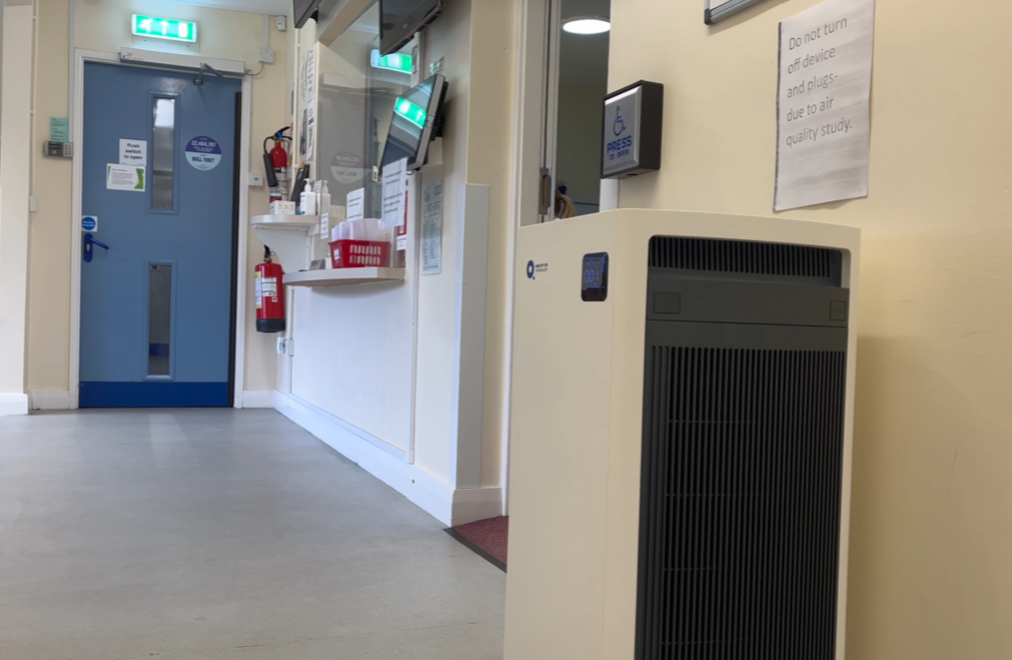
What did our general practice and dental clinic case studies show about airborne microbes?
Key points The general practice study measured airborne bacteria and mould before, during and after air purifier operation…
How can air cleaning support infection control in medical and dental clinics?
Key points Air cleaning can support infection control by reducing airborne particles and bioaerosols in treatment rooms, waiting…
Where should you place air purifiers in a room for best performance?
Key points Air purifier placement affects how well a unit draws polluted air in and distributes cleaned air…