

What did our general practice and dental clinic case studies show about airborne microbes?
5 August 2026
Key points
- The general practice study measured airborne bacteria and mould before, during and after air purifier operation in a real clinical setting.
- The strongest reduction appeared in the practice room, where measured bacteria and mould levels fell by approximately 68% during the device-testing period.
- The corridor and waiting-room area showed a smaller reduction of approximately 36%, which points to the role of foot traffic, door opening, airflow and placement.
- The dental clinic case study focused on treatment-room operation during aerosol-generating procedures, rather than microbial sampling.
- These case studies support careful, room-by-room evaluation, not broad claims about guaranteed infection reduction.
Introduction
Case studies can be useful because they show how air cleaning behaves outside a laboratory chamber. A test chamber controls volume, mixing, pollutant load, and operating time. A clinic does not. Staff move through the space, doors open, patients arrive, equipment creates heat, cleaning takes place, and sockets often decide where a portable air cleaner can realistically sit.
This article looks at two HATL clinical case studies. The first is the MTIF study at Sunrise Medical Practice in Nottingham, which measured airborne bacteria and mould over a 10-day period. The second is the Commonwealth Dental Practice case study, which looked at the use of HA500 and HA800 units in dental treatment rooms during aerosol-generating procedure pressures.
The two examples answer different questions. The general practice study tells us more about measured airborne microbial levels. The dental case study tells us more about room operation, air-change targets and clinical workflow. Reading them together gives a more useful picture than treating either one as a universal result.
What exactly was measured in the general practice study?
The MTIF study aimed to assess whether HATL air purifiers could reduce airborne bacteria and mould levels in a clinical setting over 10 days. The Medical Technologies Innovation Facility at Nottingham Trent University conducted the work at Sunrise Medical Practice, with sponsorship from Medilink Midlands under the Innovation Support Grant.
The study collected 46 air samples across three periods:
- background flora testing;
- device testing;
- post-device testing.
Researchers used Fisher Scientific growth media and incubated the samples at 32°C for two to four days.
That method gives the study a clear scope. It measured culturable bacteria and mould under the selected sampling and incubation conditions. It did not directly measure viruses, and it did not measure clinical infection outcomes. This distinction matters because airborne microbial sampling can show whether measurable biological indicators changed, but it cannot by itself prove that infection risk changed by the same percentage.
The study therefore gives useful environmental data. It should not be presented as a medical outcome study.
What did the practice-room result show?
The strongest result came from the practice room.
The MTIF report states that bacteria and mould levels fell by approximately 68% in the practice room during the device-testing period. It also reports that mould levels alone fell by 73% in that room.
This result matters because a practice room often behaves more like a defined air-cleaning zone than a corridor or reception area. It has a clearer volume, fewer people passing through, fewer door-opening events and more predictable use. Those conditions allow room air to pass through the purifier repeatedly.
A cautious interpretation would be:
The study observed a substantial reduction in measured culturable bacteria and mould in the practice room during air purifier operation.
That wording avoids overclaiming. The result relates to measured airborne microbial indicators under the study conditions, not to all pathogens or all clinical risks.
Why did the corridor and waiting-room area show a smaller reduction?
The corridor and waiting-room area showed a lower reduction. The MTIF report states that bacteria and mould levels fell by approximately 36% in that area during the device-testing period. Mould alone fell by 38%.
This finding may be more instructive than the higher practice-room result. It shows how real rooms affect air-cleaning performance.
The report identifies several likely reasons for the lower reduction:
- higher foot traffic;
- frequent opening and closing of doors;
- external air and contaminant entry;
- less controlled ventilation;
- airflow obstructions;
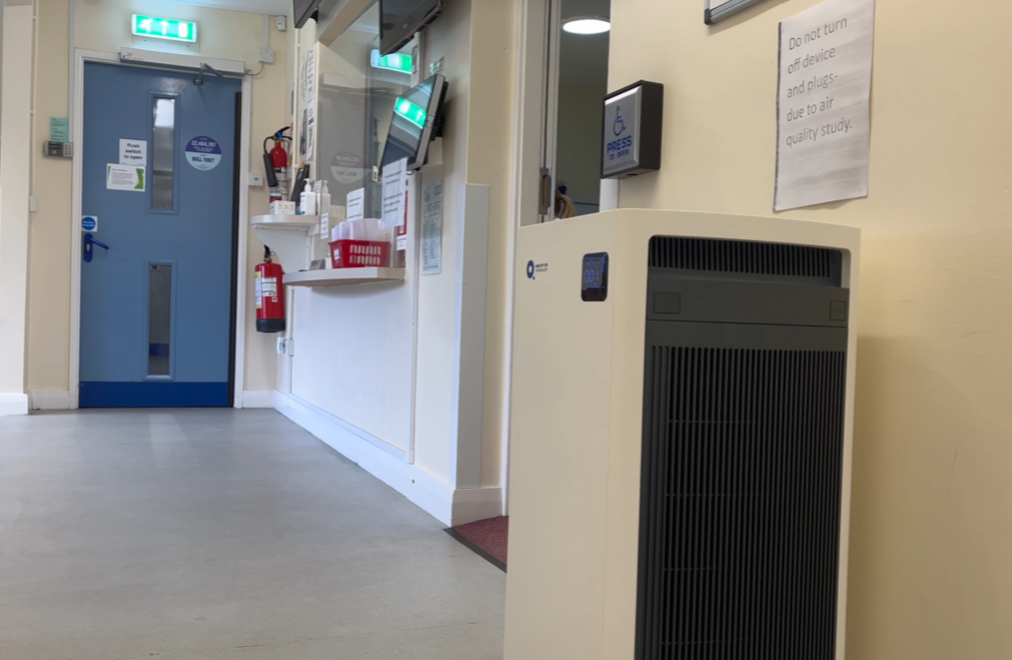
- suboptimal purifier placement caused by socket limitations.
These are not minor details. They explain why a device can perform well in one part of a clinic and less strongly in another. A waiting room constantly receives new air, new people and new particles. A corridor may connect several spaces and rarely acts like one stable room. Furniture, sockets and circulation routes can also push a unit into a position that suits the building layout more than the airflow.
For clinic managers, the lesson is straightforward: room behaviour affects microbial reduction. CADR and filtration technology matter, but they do not override poor placement, heavy movement or uncontrolled air exchange.
What did the figures suggest about timing?
The MTIF report refers to Figure 1 for bacteria and mould reduction in the practice room and corridor/waiting room, and Figure 2 for percentage mould reduction. The report summary describes a downward trend in both bacteria and mould during air purifier operation, with a stronger effect in the practice room.
The timing is relevant because the study compared background, device-testing and post-device periods. A reduction during the device-testing period suggests that the purifier contributed to the observed change. The pattern does not remove every possible confounding factor, because patient flow, cleaning, door use and outdoor conditions may also vary over 10 days.
The report itself acknowledges this point by noting variation in the data and the need for more comprehensive studies to confirm the findings. That is the right scientific position. The study provides encouraging field evidence, not a final answer for every clinic type.
What did the dental clinic case study show?
The Commonwealth Dental Practice case study looked at a different problem: dental treatment rooms during aerosol-generating procedures.
The case study states that HA500 and HA800 units were installed in treatment rooms across the Scottish dental chain. It also says that using both machines gave the practice more flexibility across different room types.
The reported outcome focuses on air changes and workflow. The case study states that the air purifiers exceeded the 10 air changes per hour benchmark referenced for dental treatment rooms and helped the practice perform treatments with reduced wait times. Dentist Patrick Balmer is quoted as saying that the units supported the ability to perform AGPs and gave staff and patients “safety combined with peace of mind.”
This case study does not present the same culture-based microbial sampling data as the MTIF general practice study. It should therefore be used differently. It supports discussion of operational use in dental treatment rooms, not a claim that the same 68% microbial reduction occurred in the dental setting.
Why do aerosol-generating procedures matter?
Dental aerosol-generating procedures can add biological and non-biological particles to the air close to the patient, clinician and treatment zone. High-speed instruments, ultrasonic scalers and air-water syringes can all contribute to airborne material, although the amount and composition vary by procedure.
A Cochrane review on contaminated dental aerosols found that studies in this area often measure bacterial contamination using colony-forming units, while evidence on disease transmission, viral contamination and fungal contamination remains limited. The review found no studies that evaluated disease transmission via aerosols in dental settings, which reinforces the need for careful wording when discussing infection outcomes.
That evidence helps frame the Commonwealth case study. The dental case study supports the operational value of supplementary air cleaning during AGP-related pressures. It does not prove a direct reduction in infection transmission.
What is the difference between particles, microbes and infection risk?
This distinction often gets lost in air-cleaning discussions.
A particle is a physical airborne object. It may be dust, skin flakes, saliva residue, droplet nuclei, smoke, outdoor PM2.5 or another material.
A microbe is a biological organism or biological entity, such as bacteria, mould or a virus. Some microbes may travel in or on particles.
An infection risk depends on many factors, including the source, pathogen, infectious dose, exposure time, ventilation, filtration, PPE, procedure type, host susceptibility and clinical protocols.
The MTIF study measured culturable bacteria and mould, not infection outcomes. The Commonwealth Dental Practice case study described AGP-related room operation, not direct microbial counts. These distinctions make the case studies more useful because they prevent one type of evidence from standing in for another.
A healthcare scoping review on portable air-cleaning technologies found wide variation in study designs, outcome measures and implementation contexts. That variation makes it difficult to translate every air-cleaning result into a single clinical conclusion.
What do the two case studies show when read together?
The case studies show three main things.
First, measured airborne microbial levels can fall during air purifier operation. The MTIF study reported reductions in bacteria and mould in both the practice room and corridor/waiting-room area, with the stronger reduction in the more controlled room.
Second, room context changes the result. The lower corridor/waiting-room reduction points to the effect of traffic, doors, ventilation dynamics and placement.
Third, dental treatment rooms have an operational challenge that extends beyond general microbial background levels. AGPs create procedure-related aerosol concerns, so practices need to consider air changes, clearance time, suction, PPE, room layout and supplementary air cleaning together. The Commonwealth case study shows how HA500 and HA800 units supported that operational context.
The strongest conclusion is not “air cleaning solves airborne infection risk”. A better conclusion is: air cleaning can reduce measured airborne microbial indicators in suitable room conditions and can support clinical-room operation when teams size, place and use devices correctly.
Why did the practice room perform better than the corridor?
The practice room probably performed better because the air cleaner had a more stable environment to work in.
A purifier needs time and repeated air movement. It draws air in, treats it and returns it to the room. In a more enclosed consultation or practice room, the same room air can pass through the device multiple times. That repeated treatment increases the chance of reducing measured airborne contaminants.
A corridor behaves differently. People walk through it. Doors open. External air enters. The space may connect multiple rooms. Furniture and socket limitations may force the purifier into a weaker position. The MTIF report specifically mentions socket limitations and airflow obstruction as factors that affected the corridor/waiting-room result.
This finding connects closely with air purifier placement. A device installed where it can draw from the occupied zone and discharge cleaned air into the room should generally have a better opportunity to perform than one pushed into a low-airflow location.
What should clinics take from the microbial data?
Clinic managers can draw several practical lessons from the MTIF results.
Controlled treatment rooms may give clearer benefits
Consultation rooms and treatment rooms often provide more predictable conditions. If the room volume, occupancy and placement are known, the air cleaner has a clearer task.
Waiting areas need more careful planning
Waiting rooms and corridors may still benefit from air cleaning, but they may need a different design approach. One unit in a busy circulation space may not provide uniform coverage. Several smaller units, better positioning, or a review of ventilation and door management may work better.
Placement can limit performance
The MTIF report directly links the lower corridor/waiting-room result partly to suboptimal placement. This makes placement a performance factor, not a cosmetic decision.
Microbial sampling needs careful interpretation
Culture-based sampling can show changes in culturable bacteria and mould. It does not capture every airborne biological particle, and it does not measure viruses unless the study specifically includes viral methods.
Claims should match the evidence
The case study supports statements about measured airborne bacteria and mould reductions. It does not support a claim that infection risk fell by the same percentage.
How could future clinic case studies be strengthened?
Future studies could build on the MTIF approach by adding more environmental and operational data.
A stronger study design might include:
- longer sampling periods;
- repeated testing across seasons;
- matched rooms with and without devices;
- particle counting alongside microbial sampling;
- CO₂ monitoring to assess ventilation adequacy;
- room-volume and CADR calculations;
- records of door opening and occupancy;
- standardised purifier placement;
- separate reporting for treatment rooms, waiting rooms and corridors;
- procedure-specific sampling in dental settings.
Dental studies could also compare background periods, AGP periods and post-AGP clearance times with the air cleaner off and on. That would help separate general background microbial levels from procedure-related aerosol behaviour.
These additions would not undermine the current case studies. They would make the next stage of evidence more precise.
What should these case studies not be used to claim?
The case studies should not be used for absolute statements.
Avoid saying:
- “The air purifier prevents infection.”
- “Every clinic will see a 68% reduction.”
- “Waiting rooms perform like treatment rooms.”
- “Air cleaning replaces ventilation.”
- “The dental case study proves microbial reduction during every AGP.”
- “The device removes all airborne pathogens.”
More accurate wording would be:
- “The MTIF study observed reductions in measured airborne bacteria and mould during device operation.”
- “The strongest reduction appeared in the more controlled practice room.”
- “The corridor and waiting-room data showed lower reductions, likely due to traffic, ventilation dynamics and placement.”
- “The dental case study showed operational use during AGP-related room-management pressures.”
- “Further studies would help confirm performance across more room types and clinical settings.”
This language keeps the article credible and useful for clinical readers.
Summary
The general practice and dental clinic case studies show different but complementary evidence.
The MTIF general practice study measured airborne bacteria and mould over a 10-day period at Sunrise Medical Practice. It reported approximately 68% lower bacteria and mould levels in the practice room and approximately 36% lower levels in the corridor/waiting-room area during device operation. Mould alone fell by 73% in the practice room and 38% in the corridor/waiting-room area.
The report also explains why the waiting-room and corridor result was lower: higher foot traffic, door opening, less controlled ventilation and suboptimal placement all affected performance.
The Commonwealth Dental Practice case study gives a different type of evidence. It describes how HA500 and HA800 units supported dental treatment-room operation during AGP-related pressures and helped the practice work around air-change and waiting-time constraints.
Taken together, the case studies support a careful conclusion: air cleaning can reduce measured airborne microbial indicators in clinical rooms under suitable conditions, and it can support dental-room operation when teams integrate it with ventilation, procedure controls and local risk assessment. The results also show why real-room factors matter. Foot traffic, door opening, airflow, placement, and occupancy can all change the outcome.
Latest News
How can air purification improve air quality in offices and co-working spaces?
Key points Offices and co-working spaces often contain a mixed pollutant profile: outdoor particles, indoor dust, VOCs, bioaerosols,…

What a UK study reveals about indoor air triggers in asthma and COPD
Dust, smoke, cooking particles, fragrances, and mould were among the everyday indoor-air concerns identified by people with asthma and…

How can schools, universities and training centres use air cleaning effectively?
Key points Air cleaning can help reduce airborne particles in classrooms, lecture rooms, libraries, training rooms and shared…