

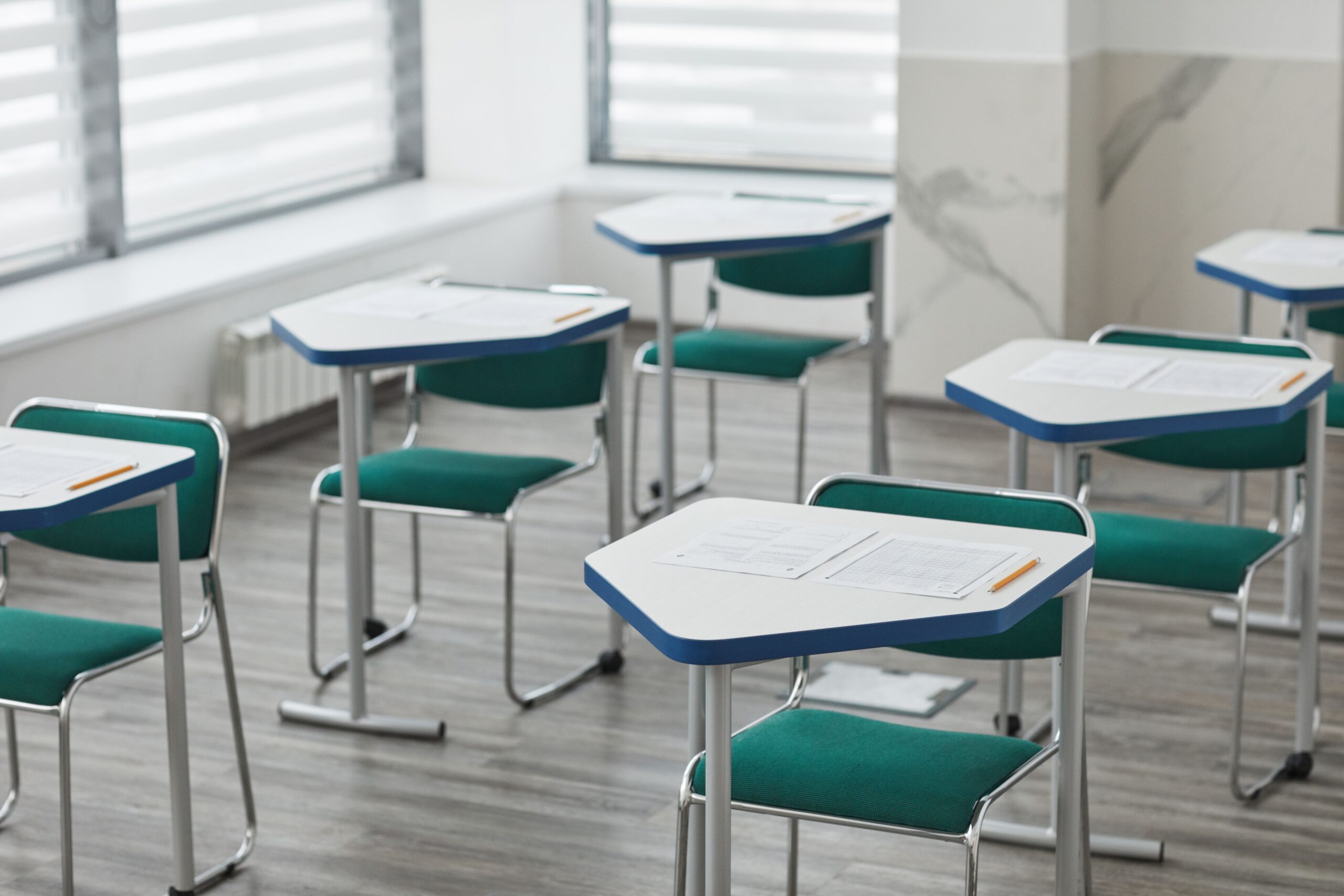
How can schools, universities and training centres use air cleaning effectively?
2 September 2026
Key points
- Air cleaning can help reduce airborne particles in classrooms, lecture rooms, libraries, training rooms and shared learning spaces.
- It works best as part of a wider indoor air quality strategy that includes ventilation, source control, cleaning, monitoring and maintenance.
- Correct sizing matters: facilities teams should match Clean Air Delivery Rate to room volume, occupancy and use pattern.
- CO₂ monitoring remains important because most portable air cleaners do not remove carbon dioxide.
- Education settings should prioritise rooms with poor ventilation, high occupancy, vulnerable users, long dwell times or limited upgrade options.
Introduction
Education buildings create a particular indoor air quality challenge. Classrooms often have high occupancy for long periods. Lecture theatres may fill and empty several times a day. Training centres can combine workshops, practical activities, computers, cleaning products, changing groups and variable ventilation. Many school and university buildings also include older rooms that were not designed for modern occupancy levels.
Air cleaning can help in these environments, but it needs careful use. A portable air cleaner is not a substitute for a well-managed ventilation strategy. It does not remove every pollutant, and it does not solve poor maintenance, blocked vents or excessive occupancy. It can, however, add recirculated clean air to spaces where particle levels or ventilation constraints need additional control.
Recent guidance reflects this layered view. The Department for Education’s guidance for education and childcare settings covers monitoring air quality, maintaining adequate ventilation and using air cleaning units where appropriate. It also includes a separate specification for air cleaning units, which indicates that schools should treat device selection as a technical decision rather than a general purchase.
What problem should education settings solve first?
Schools, universities and training centres should begin with the room, not the product.
A classroom beside a busy road has a different air quality problem from a seminar room with high CO₂. A science room has different sources from a library. A workshop with dust-generating activity needs a different approach from a nursery room with high occupancy and frequent cleaning.
The first step is to identify the dominant problem:
- high CO₂ from insufficient ventilation;
- fine particles from outdoor pollution;
- particles from indoor activity;
- bioaerosols from dense occupancy;
- VOCs from materials, cleaning, paints or furnishings;
- odours or moisture from poor air movement;
- local pollutant sources such as printers, workshops or food areas.
Air cleaning helps most directly with particles. HEPA-based devices can capture fine airborne particles as air passes through the unit. Additional media may address selected gases or VOCs, but the school should check the test evidence for the specific pollutant, device and operating conditions.
Ventilation still matters. CO₂ monitoring can show when an occupied room needs more outdoor air, lower occupancy or a ventilation review. A purifier may reduce particle levels while CO₂ remains high, so facilities teams should avoid treating a low particle reading as proof of adequate ventilation.
Where should schools and colleges prioritise air cleaning?
Education estates often contain too many rooms for every space to receive the same intervention at once. A risk-based approach makes better use of budgets.
Priority rooms often include:
- classrooms with persistently high CO₂;
- rooms where windows cannot open safely or effectively;
- learning spaces near busy roads or pollution sources;
- music, drama or activity rooms with high respiratory output;
- small intervention rooms used by several groups each day;
- nurse rooms, welfare rooms or isolation spaces;
- staff rooms with dense occupancy at break times;
- lecture theatres with long sessions and high occupancy;
- practical training rooms where activities generate particles;
- older rooms where HVAC upgrades will take time.
CDC school ventilation guidance recommends improving ventilation, maintaining HVAC systems, improving filtration and considering portable HEPA air cleaners, especially in higher-risk areas such as nurse or isolation rooms.
For UK schools, the Department for Education guidance provides the relevant operational starting point. It asks education settings to monitor and manage ventilation and air quality, and it recognises air cleaning units as one possible measure within that broader process.
How should facilities teams size air cleaners for classrooms?
Sizing should start with room volume.
Room volume = floor area × ceiling height
Then compare the room volume with the air cleaner’s Clean Air Delivery Rate, or CADR.
Equivalent air changes per hour from the air cleaner = CADR ÷ room volume
For example:
Classroom floor area: 60 m²
Ceiling height: 3 m
Room volume: 180 m³
Air cleaner CADR: 600 m³/h
Equivalent clean air from device:
600 ÷ 180 = 3.3 equivalent air changes per hour
This does not mean the room receives 3.3 outdoor air changes per hour. It means the air cleaner delivers particle-cleaned recirculated air at that equivalent rate.
ASHRAE-linked school IAQ guidance has discussed targets such as 4–6 equivalent air changes per hour in classrooms through HVAC filtration, outdoor air or portable HEPA units. This gives facilities teams a useful benchmark, although each room still needs assessment against local standards, occupancy, pollutant sources and practical constraints.
The useful CADR is the CADR at the fan speed the room can tolerate. A unit may achieve its highest CADR on turbo mode, but that mode may disturb teaching, lectures or exams. Noise therefore affects real performance.
Where should air cleaners be placed in learning spaces?
Placement affects performance as much as selection.
A unit needs clear intake and outlet airflow. It should not sit behind a cupboard, under a desk, inside an alcove or tight against curtains. Staff should also avoid placing it where pupils or students will switch it off, unplug it, cover it with bags or complain about a direct draught.
Good placement usually means:
- inside the room it serves;
- away from blocked corners;
- close enough to the occupied zone to be useful;
- positioned with clear air paths;
- away from high-risk trip routes;
- away from direct interference by students;
- accessible for filter checks and cleaning.
In classrooms, side-wall positions often work better than hidden corners. In lecture theatres, multiple smaller units may distribute clean air more evenly than one large unit near the entrance. In workshops or training rooms, staff should place units where they support general air cleaning without interfering with local extraction, safety zones or equipment use.
Large spaces need more than a single number. Libraries, gyms, halls and open learning centres often require zoning. A CADR calculation may show enough total clean air on paper, but the room may still contain poorly mixed areas if the units sit in the wrong places.
How should air cleaning interact with ventilation?
Air cleaning and ventilation do different jobs.
Ventilation brings outdoor air into the building and removes or dilutes indoor air. It helps manage CO₂, moisture, odours and a broad range of indoor pollutants. Air cleaning recirculates indoor air through a treatment system and returns treated air to the same space.
That distinction matters in education settings because CO₂ can build quickly during lessons. A portable air cleaner may reduce PM2.5 or airborne particle levels, but it will not usually lower CO₂. If a classroom repeatedly exceeds the school’s CO₂ threshold, the team still needs to improve outdoor air supply, reduce occupancy, change room use or review the ventilation system.
The JARED guidance for educational institutions recommends using CO₂ sensors to indicate when indoor air needs ventilation, with suggested alarm levels of 900–1250 ppm for acceptable air quality and lower values during epidemic seasons or after refurbishment periods.
The practical message is simple: use air cleaning to add particle-focused clean air, not to hide ventilation problems.
Can air cleaning help with outdoor pollution near schools?
Outdoor pollution can enter classrooms through windows, doors, cracks and mechanical ventilation. Schools near busy roads may face a difficult trade-off: opening windows can reduce CO₂, but it may also admit traffic-related particles or nitrogen dioxide.
Air cleaning can help reduce some indoor particle levels in this situation, especially where outdoor PM2.5 or PM10 contributes to the indoor load. It does not solve outdoor pollution at the source, and it does not remove the need to manage drop-off zones, idling, traffic exposure or filtered mechanical ventilation where needed.
A 2025 report on UK classroom monitoring through the SAMHE project found that outdoor pollution made a major contribution to indoor classroom particle levels, and it reported that air filters tested with Hertfordshire County Council reduced particle levels by 29%. The same report also stressed that schools should maintain ventilation because ventilation supports CO₂ control and infection-risk reduction.
This is a good example of the balance. Closing windows may not solve particle exposure, and leaving them open may not solve every IAQ problem. Schools need monitoring, filtration, ventilation and outdoor source control to work together.
How can universities and training centres apply the same principles?
Universities and training centres often have more complex estates than schools. A campus may include lecture theatres, labs, libraries, studios, IT rooms, clinical simulation spaces, workshops, accommodation and social spaces.
The same air-cleaning principles apply, but the implementation needs more room-specific planning.
Lecture theatres need enough clean air for dense occupancy and long sessions. Libraries need quiet operation, so fan speed and noise matter. Practical training rooms may need local extraction before portable air cleaning. Computer rooms may have heat loads and limited window opening. Clinical training suites may need infection-control review if students practise procedures.
Universities should also avoid uncontrolled purchasing by individual departments. A central specification helps estates teams manage filters, maintenance, electrical safety, noise, placement and replacement cycles. Without that structure, devices may sit unused, filters may expire, and rooms may gain equipment that no one has assessed.
What role can monitoring play?
Monitoring turns air cleaning from a one-off purchase into a managed system.
CO₂ sensors help staff identify rooms with inadequate ventilation during occupancy. PM2.5 sensors can show whether particle levels change when air cleaners operate. Temperature and humidity readings can flag comfort and moisture issues. Some VOC sensors can help with trends, although many low-cost VOC sensors need careful interpretation.
Schools should avoid relying on one sensor type. CO₂ tells a useful story about ventilation and occupancy. PM2.5 tells a different story about particles. Neither one tells the whole story about VOCs, microbes, comfort or filtration performance.
The Department for Education guidance specifically covers monitoring air quality and managing ventilation in education and childcare settings. That makes monitoring part of building operation, not an optional extra.
A useful review process could include:
- termly checks of rooms with known ventilation issues;
- spot checks during high occupancy;
- filter-change records;
- staff feedback on noise and comfort;
- comparison of PM2.5 trends before and after installation;
- review after room layout changes;
- checks during winter, summer and high outdoor pollution events.
What about energy use and carbon goals?
Education settings face pressure to improve indoor air quality while controlling energy costs. More outdoor air can improve dilution, but it may also increase heating or cooling demand. Air cleaning can sometimes help reduce particle exposure without increasing outdoor air supply as much, but it cannot remove the need for ventilation.
A modelling study of HEPA units in classrooms predicted reductions in PM2.5 and airborne viral RNA under the modelled conditions. It also found that when window opening was reduced while HEPA units operated, heating costs could fall, but CO₂ levels increased significantly.
That trade-off is central. Air cleaning can support energy-conscious IAQ strategies, but it should not justify reducing outdoor air to the point where CO₂ or moisture control deteriorates.
A sensible carbon strategy combines:
- source control;
- appropriate outdoor air ventilation;
- efficient HVAC operation;
- good filtration;
- correctly sized room air cleaning;
- monitoring;
- scheduled maintenance;
- careful seasonal operation.
How should schools maintain air cleaning units?
Maintenance determines long-term performance.
A school may install a well-sized unit in September and lose performance by spring if no one checks the filter. Dust loading can reduce airflow. Damaged seals can allow bypass. Staff may move units during room changes. Students may block outlets with bags or displays.
Each site should assign responsibility for:
- checking units remain in the correct room;
- inspecting inlets and outlets;
- cleaning external surfaces;
- replacing filters or media on schedule;
- recording filter changes;
- checking fan speeds;
- confirming units run during occupied periods;
- removing damaged or noisy devices from service.
Procurement should include replacement filters and a maintenance plan. Otherwise, the school buys a device but not the performance it expected from the device.
Where do HEPA and DNO systems fit in education settings?
HATL systems that combine HEPA filtration with DNO catalytic technology can support a broader air cleaning strategy. The HEPA stage captures particles from the air passing through the unit. The DNO catalytic stage is designed to address selected gaseous pollutants through surface-based catalytic processes.
Education settings should describe these roles separately. HEPA filtration supports particle reduction. DNO catalytic technology may broaden pollutant treatment where test evidence supports the specific application. Neither mechanism removes the need for outdoor air ventilation, CO₂ monitoring or source control.
This distinction becomes useful in schools and universities because pollutant types vary. Classrooms may need particle-focused clean air and CO₂ management. Art rooms may need source control and ventilation for materials. New furniture and refurbishment periods may raise VOC concerns. Workshops may require local extraction. A combined air cleaning approach can contribute, but the site still needs to match the technology to the pollutant.
What should education settings avoid?
Schools, universities and training centres should avoid several common mistakes.
Buying units without room calculations
A device that suits a small office may not suit a classroom. Match CADR to room volume and use pattern.
Placing units where they cannot move air
Corners, cupboards and blocked outlets reduce performance.
Treating air cleaning as ventilation
Most portable units do not remove CO₂. Keep ventilation assessment in place.
Ignoring noise
A loud unit may end up switched off. Choose a device that can deliver useful CADR at an acceptable sound level.
Forgetting maintenance
A neglected filter undermines performance and confidence.
Making unsupported health claims
Air cleaning can reduce airborne particle concentrations and may support exposure reduction. It should not carry claims that it prevents illness or keeps students safe in all conditions.
What does an effective education air-cleaning plan look like?
An effective plan does not need to be complicated, but it should be systematic.
Start by ranking rooms according to occupancy, ventilation concerns, pollutant sources and vulnerability of users. Measure CO₂ where possible. Identify rooms near outdoor pollution sources. Review HVAC performance, window use and existing filtration.
Next, select devices by room volume, CADR, noise, filtration type, maintenance requirements and evidence for the relevant pollutants. Place units so they can draw room air in and return cleaned air without obstruction. Train staff on operation and basic checks.
Finally, review performance. Use CO₂ and PM2.5 trends where available. Check whether staff can tolerate the fan speed. Confirm that filters get replaced. Reassess after timetable changes, refurbishment, seasonal changes or new room layouts.
Summary
Schools, universities and training centres can use air cleaning effectively when they treat it as part of a managed indoor air quality strategy. The best results come from matching the device to the room, placing it correctly, running it consistently and maintaining it over time.
Air cleaning can add useful particle-focused clean air in classrooms, lecture rooms, welfare spaces and training rooms. It may prove especially useful where ventilation upgrades take time, where outdoor pollution creates a difficult window-opening trade-off, or where high occupancy makes additional clean air valuable.
It should not replace ventilation. CO₂, moisture, odours and many gases still require outdoor air, source control or specialist systems. The strongest approach combines ventilation, filtration, air cleaning, monitoring, maintenance and clear operating responsibility.
Latest News
How can air purification improve air quality in offices and co-working spaces?
Key points Offices and co-working spaces often contain a mixed pollutant profile: outdoor particles, indoor dust, VOCs, bioaerosols,…
What a UK study reveals about indoor air triggers in asthma and COPD
Dust, smoke, cooking particles, fragrances, and mould were among the everyday indoor-air concerns identified by people with asthma and…
How can schools, universities and training centres use air cleaning effectively?
Key points Air cleaning can help reduce airborne particles in classrooms, lecture rooms, libraries, training rooms and shared…