

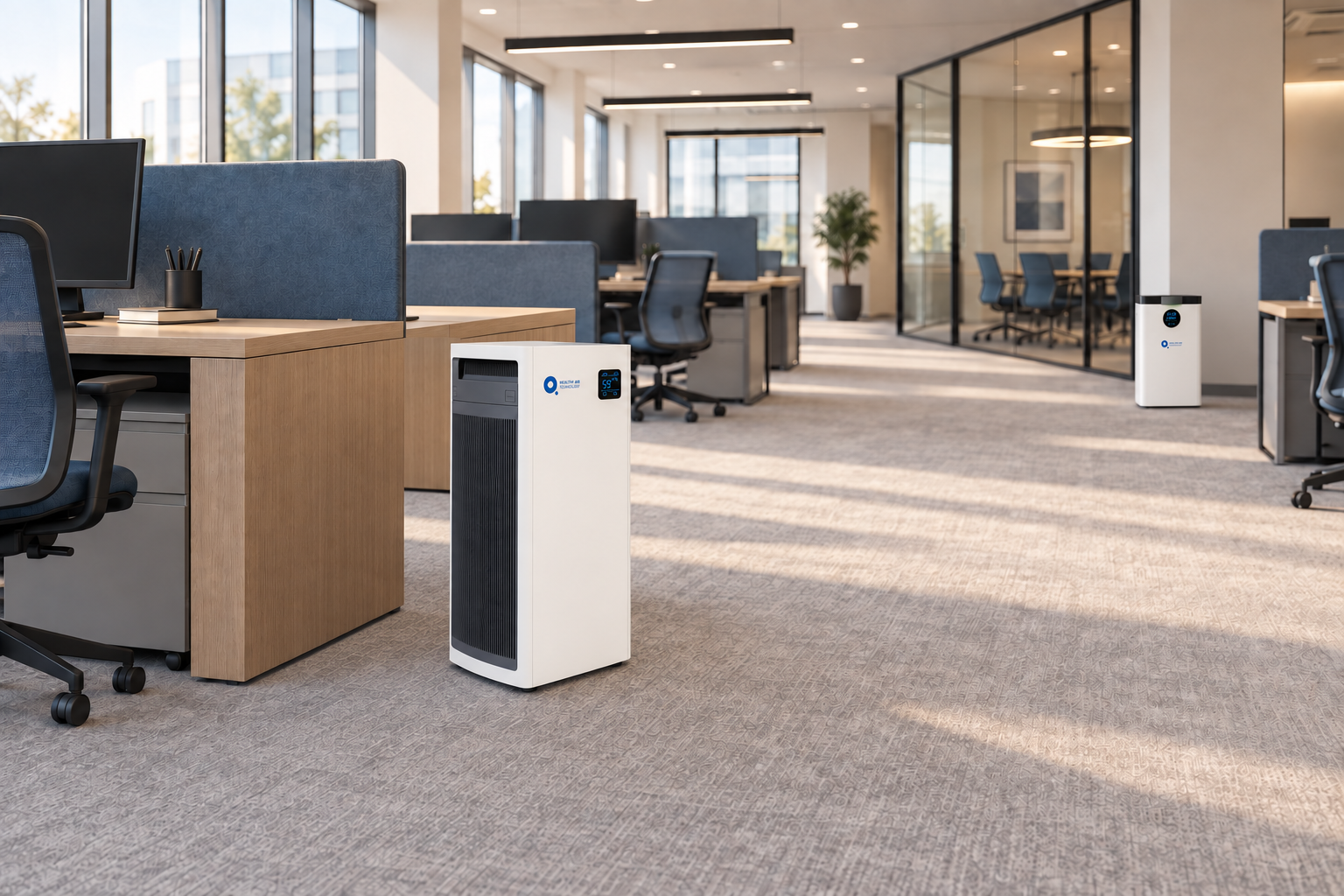
How can air purification improve air quality in offices and co-working spaces?
24 September 2026
Key points
- Offices and co-working spaces often contain a mixed pollutant profile: outdoor particles, indoor dust, VOCs, bioaerosols, cleaning residues and CO₂ from occupancy.
- Air purification can help reduce airborne particles and, where suitable gas-phase technology is used, may also support management of selected VOCs and odours.
- Air cleaners should work alongside ventilation, source control, HVAC maintenance and monitoring rather than replace them.
- Open-plan offices need careful sizing and placement because furniture, partitions, meeting pods and occupancy patterns affect real-room performance.
- Facilities teams should evaluate CADR, noise, energy use, pollutant type, placement and filter maintenance before judging performance.
Introduction
Offices have changed. Many now operate with hybrid occupancy, open-plan, shared collaboration spaces and co-working zones that change throughout the week. These patterns make indoor air quality harder to manage.
Air purification can add recirculated clean air where people work, meet and spend time. It can reduce airborne particle concentrations, support filtration in rooms where ventilation upgrades are difficult, and help facilities teams respond to variable occupancy. Effective deployment starts with the room: identify the pollutant problem, calculate the required clean-air delivery, choose an acceptable fan speed, position the unit well, and assign maintenance responsibility.
Air cleaning remains one part of a wider indoor air quality strategy. Offices still need source control, suitable outdoor-air ventilation, HVAC maintenance and monitoring. EPA guidance describes the same layered approach.
What pollutants affect office and co-working spaces?
Office air contains pollutants from both indoor and outdoor sources.
Outdoor particles can enter through ventilation intakes, doors, windows and infiltration. In urban offices, traffic-related PM2.5 and nitrogen dioxide may contribute to the indoor pollutant load. Indoor sources then add their own mixture: skin flakes, textile fibres, paper dust, cleaning products, furniture emissions, printers, kitchens, fragrances and resuspended dust from movement.
Co-working spaces can create additional variability. One day may bring quiet laptop work. Another may bring events, workshops, visitors, catering or long meetings in enclosed rooms. That variation affects pollutant generation and ventilation demand.
The main pollutant groups include:
- fine particles, including PM2.5;
- larger dust and fibres;
- VOCs from materials, cleaning and furnishings;
- odours from food, waste or occupation;
- bioaerosols from people and activity;
- CO₂ from occupants;
- outdoor-derived gases and particles.
CIBSE’s indoor air quality and ventilation guidance describes common IAQ concerns including gaseous pollutants, VOCs, odours, particulates, water vapour, outdoor pollution and the relationship between ventilation, comfort and occupant performance.
Air purification can help with some of these pollutants, but it cannot treat all of them equally. HEPA filtration targets particles. Gas-phase media or catalytic technologies address selected gases or VOCs only where the technology and test evidence support that application. CO₂ still needs ventilation, occupancy management or another dedicated strategy.
How does air purification improve office air quality?
Air purification improves office air quality by increasing the amount of treated air delivered to the occupied space.
A portable air cleaner draws room air into the device, passes it through filtration or treatment stages, and returns treated air to the room. For particle control, Clean Air Delivery Rate is the key sizing metric. CADR estimates how much particle-cleaned air the device supplies per hour.
A simple room calculation is:
Equivalent clean air changes per hour = CADR ÷ room volume
For example:
Meeting room volume: 90 m³
Air cleaner CADR: 450 m³/h
Equivalent air cleaning rate:
450 ÷ 90 = 5 equivalent air changes per hour
This does not mean the room receives five outdoor air changes per hour. It means the unit supplies particle-cleaned recirculated air at that equivalent rate.
ASHRAE’s 2024 position document states that filtration and air cleaning can effectively improve air quality when used properly. It also cautions that technology choice, safety, standardised testing, air distribution, maintenance, airflow rate, installation and space volume all affect performance.
In offices, published performance is a starting point; layout, air distribution, fan speed and maintenance determine how much clean air reaches the occupied zone.
Which office areas benefit most from air purification?
Not every office space needs the same intervention. Facilities teams should prioritise rooms where people spend time, pollutant sources exist, ventilation has limits or occupancy changes quickly.
Useful priority areas include:
- enclosed meeting rooms;
- co-working zones with high desk turnover;
- reception areas and waiting spaces;
- print and copy rooms;
- staff rooms and kitchens;
- rooms near busy roads or car parks;
- small cellular offices with limited ventilation;
- hot-desk areas with variable occupancy;
- podcast rooms, focus rooms or phone booths;
- training rooms and event spaces.
Meeting rooms often deserve early attention because occupancy can rise quickly in a small volume. Use CO₂ readings to assess whether outdoor-air supply matches occupancy, and particle monitoring to judge where filtration may help.
For open-plan and co-working areas, divide the floor into occupied zones rather than relying on one unit near a wall. Distribute units where clean air is needed, keep inlets and outlets clear, and set clear rules for operation and maintenance.
How should offices manage particles, VOCs and CO₂ differently?
Office IAQ decisions improve when teams separate pollutant types.
Particles
HEPA filtration can capture airborne particles from the air passing through the device. This includes fine particulate matter, dust, pollen and some particle-associated bioaerosols. Particle reduction depends on CADR, room volume, air mixing, filter condition and run time.
VOCs and odours
VOCs need a different treatment route. Source control should come first: choose lower-emission materials, store chemicals properly, manage cleaning products and review refurbishment schedules. Ventilation then helps dilute and remove gaseous pollutants.
Air purification may support VOC management if the device includes suitable gas-phase treatment. Activated carbon can adsorb some VOCs until capacity declines. Catalytic media may transform selected compounds under defined conditions. Claims should stay specific to tested pollutants and operating conditions.
CO₂
CO₂ mainly reflects occupancy and ventilation. Most air purifiers do not remove it. A room can show low particle levels and high CO₂ at the same time. For offices and co-working spaces, CO₂ monitoring helps identify meeting rooms, training rooms and shared spaces where outdoor air supply does not match occupancy.
This distinction avoids a common mistake: treating “good air quality” as one number. PM2.5, VOCs and CO₂ describe different parts of the indoor air picture.
What does office research suggest about IAQ and work performance?
Research on offices does not support exaggerated claims such as “air purification guarantees productivity.” It does, however, show that indoor environmental quality can influence how people feel and perform at work.
The Harvard Healthy Buildings COGfx programme examined links between office indoor air quality and cognitive function. Its published summaries report that cognitive function scores improved under green building and enhanced ventilation conditions compared with conventional conditions, and related work found associations between indoor PM2.5, CO₂ and aspects of cognitive performance in office workers.
This evidence does not mean an air purifier alone will improve every office outcome. Ventilation, filtration, pollutant sources, temperature, lighting, noise, management culture and work design all contribute. A measured interpretation is more useful: better-managed indoor air may contribute to a more comfortable and supportive working environment, especially where previous conditions included high particles, high CO₂ or noticeable odours.
For co-working providers, that framing matters. Air quality can form part of the service environment, but it should sit beside acoustic comfort, lighting, layout, thermal comfort, cleaning and maintenance.
How should offices size air purifiers?
Sizing starts with the room or zone.
For a single room:
Room volume = floor area × ceiling height
Then compare room volume with CADR at the fan speed people will actually tolerate.
For example:
Office room: 40 m²
Ceiling height: 2.7 m
Room volume: 108 m³
Air purifier CADR: 500 m³/h
Equivalent particle-focused clean air:
500 ÷ 108 = 4.6 equivalent air changes per hour
That calculation helps teams compare devices, but it does not solve every design question. Open-plan offices often need zone-based calculations because one large volume may include desks, meeting areas, partitions and enclosed pods.
Noise also changes sizing. A unit that provides adequate CADR only on its loudest setting may not work in a meeting room or focus area. The useful CADR is the CADR at a fan speed occupants accept during normal use.
Check the selected model’s current product specifications and Evidence & Test Results before using its CADR, coverage and operating-noise figures to size an office space.
These figures help with early selection, but the final decision should still account for room volume, layout, fan-speed noise, pollutant source and placement.
Where should air purifiers go in an office?
Placement determines whether clean air reaches the occupied zone.
A good office position usually has:
- clear space around the inlet;
- an unobstructed discharge path;
- access for maintenance;
- enough distance from desks to avoid uncomfortable draughts;
- no immediate short-circuit to an extract grille;
- no blockage from cabinets, screens or soft seating.
Meeting rooms often work best with a unit placed to one side of the room, not hidden under the table or behind chairs. The outlet should help mix air across the room without blowing directly across one person’s face.
Open-plan floors need more planning. Partitions, acoustic booths, shelves and plants can divide airflow. A device near the entrance may clean the entrance area well but leave the far desks less affected. Several units distributed across zones may perform better than one unit placed for visual convenience.
Co-working spaces should also consider user behaviour. If members can unplug or move a device, performance becomes inconsistent. Clear positioning, cable management and staff checks help maintain operation.
How can air purification support hybrid and co-working patterns?
Hybrid occupancy changes where and when clean air is needed. Facilities teams can use room bookings, CO₂ and PM2.5 trends, complaints and observed use to identify meeting rooms and high-use zones that need attention, then operate correctly sized units during occupied periods.
Co-working providers should combine monitoring, source control, ventilation, HVAC maintenance and clear ownership of air-cleaning equipment. This keeps the response matched to changing room use without treating a portable unit as a complete air-quality solution.
Where do HEPA and DNO fit in office settings?
Healthy Air Technology uses HEPA filtration with D-orbital nano oxide catalytic technology. The roles are different and should remain distinct.
HEPA filtration captures particles physically as air passes through the filter. This makes it relevant to PM2.5, dust, pollen and particle-associated bioaerosols.
DNO catalytic technology is designed to address selected gaseous pollutants through surface-based catalytic processes. In office communication, it should not become a broad claim that the device removes every gas or chemical. A more accurate explanation is that HEPA and DNO provide complementary treatment: particles are captured physically, while selected gases and VOCs may be addressed catalytically where test evidence supports the application.
HATL’s external overview positions HA500 and HA800 for healthcare, clinics, offices and retrofit settings, with HEPA13, patented DNO catalyst, PM2.5 sensing, automatic electronic control and CFD-informed airflow for occupied spaces. It also states that performance depends on room size, placement, ventilation, occupancy, pollutant load and maintenance.
How should facilities teams evaluate performance?
A useful office IAQ review should combine calculation, observation and measurement.
Start with the building:
- Which rooms receive complaints about stuffiness, odours or dust?
- Where do CO₂ levels rise during occupancy?
- Which spaces have limited ventilation or no openable windows?
- What outdoor pollution sources affect the building?
- Which activities produce particles or VOCs?
Then assess each air purifier:
- What CADR does it deliver at the intended fan speed?
- Which pollutants does the device target?
- Does the unit have relevant test evidence?
- Can staff place it without blocking airflow?
- Will occupants tolerate the sound level?
- Who will replace filters and check operation?
- How will the team monitor results?
After installation, track trends rather than isolated readings. PM2.5 may change with outdoor air, cleaning, cooking, printers, commuting periods and weather. CO₂ changes with occupancy and ventilation. VOC readings may vary after cleaning, deliveries or refurbishment. A good review looks for patterns across normal use.
Review performance after changes to occupancy, layout, fan speed or maintenance, rather than treating installation as the end of the process.
What mistakes should offices avoid?
Several common mistakes reduce value.
Treating air purification as a substitute for ventilation
Air cleaners can reduce particles, but most do not remove CO₂. Offices still need outdoor air and ventilation assessment.
Buying on CADR alone
CADR matters, but noise, placement, energy use, maintenance and pollutant type matter too.
Placing units where they look tidy
Corners, cupboards and blocked areas often reduce airflow. A visible, well-positioned unit usually performs better than a hidden one.
Ignoring VOC sources
New furniture, cleaning sprays, adhesives and refurbishment materials can emit VOCs. Source control and ventilation should come before reliance on air treatment.
Running devices only during complaints
Air purification usually works best when it runs consistently during occupied periods, not only after people notice odours or stuffiness.
Forgetting filter replacement
Loaded filters can reduce airflow and performance. Maintenance records should form part of the IAQ plan.
How can offices build a simple air purification plan?
A simple plan can work well if facilities teams apply it consistently.
First, map the office into zones: open-plan desks, meeting rooms, focus rooms, staff areas, print rooms and reception. Note occupancy, room volume, ventilation type and known complaints.
Next, measure or review CO₂ and PM2.5 where possible. This helps distinguish ventilation problems from particle problems. A high-CO₂ meeting room needs outdoor air attention even if an air purifier reduces particles.
Then size air cleaners using CADR and room volume. Select devices that can deliver useful clean air at an acceptable sound level. Place units where they support the occupied zone and avoid airflow obstruction.
Finally, assign responsibility. Someone must check that devices run, filters get changed, sensors work and rooms remain suitable after layout changes. Without that ownership, performance will drift.
Summary
Air purification can improve office and co-working air quality by adding treated recirculated air to selected rooms and zones. HEPA filtration addresses particles, while suitable gas-phase or catalytic media may support selected VOC and odour control where test evidence applies.
The strongest office strategy combines source control, ventilation, correctly sized and positioned air cleaners, monitoring and maintenance. In co-working spaces, clear operating responsibility is especially important because occupancy and room use change throughout the day.
Latest News
How can air purification improve air quality in offices and co-working spaces?
Key points Offices and co-working spaces often contain a mixed pollutant profile: outdoor particles, indoor dust, VOCs, bioaerosols,…

What a UK study reveals about indoor air triggers in asthma and COPD
Dust, smoke, cooking particles, fragrances, and mould were among the everyday indoor-air concerns identified by people with asthma and…

How can schools, universities and training centres use air cleaning effectively?
Key points Air cleaning can help reduce airborne particles in classrooms, lecture rooms, libraries, training rooms and shared…