


Core Technology – The D-Orbital Nano Oxide (DNO) Catalyst
18 November 2022
The DNO catalyst
All Healthy Air Purifiers are powered by our unique patented D-Orbital Nano Oxide (DNO) catalyst technology. It is designed to break down selected gaseous pollutants at the catalyst surface. In laboratory chamber tests, the HA500 and HA800 each reduced the H1N1 virus indicator and the bacteria E. coli and S. albus by at least 99.9% within 60 minutes; see our Evidence & Test Results page.
The background
The DNO catalyst technology was developed by Dr Tiancun Xiao, an Oxford University scientist, and was the culmination of over a decade of research at the institute. From his research, Healthy Air Technology was born, and all our machines have been designed to best take advantage of his scientific developments.
Why it’s different:
Traditional air purifiers use filters to capture pollutants, letting the purified air be released into the room. This approach often lets bacteria, viruses, and pollution be re-released at a later point, known as “secondary release”. The DNO catalyst stage is designed to break down selected gaseous pollutants at the catalyst surface rather than only holding them. Results are model-specific and do not establish that secondary release is impossible; see our Evidence & Test Results page.
Where can I learn more?
Wondering how DNO compares with photocatalytic (PCO), plasma and UV air cleaners? Read How DNO differs from PCO, plasma and UV air cleaners.
If you’d like to learn more about our units, head to our product page here: https://healthyairtech.com/our-products/
You can also use our contact page if you have any questions for us, or would like to chat about our products and find out if they would work for you: https://healthyairtech.com/contact/
To learn more about our core technologies, check out our technology page or feel free to contact us for a copy of the DNO catalyst technology whitepaper: https://healthyairtech.com/technology/
Latest News
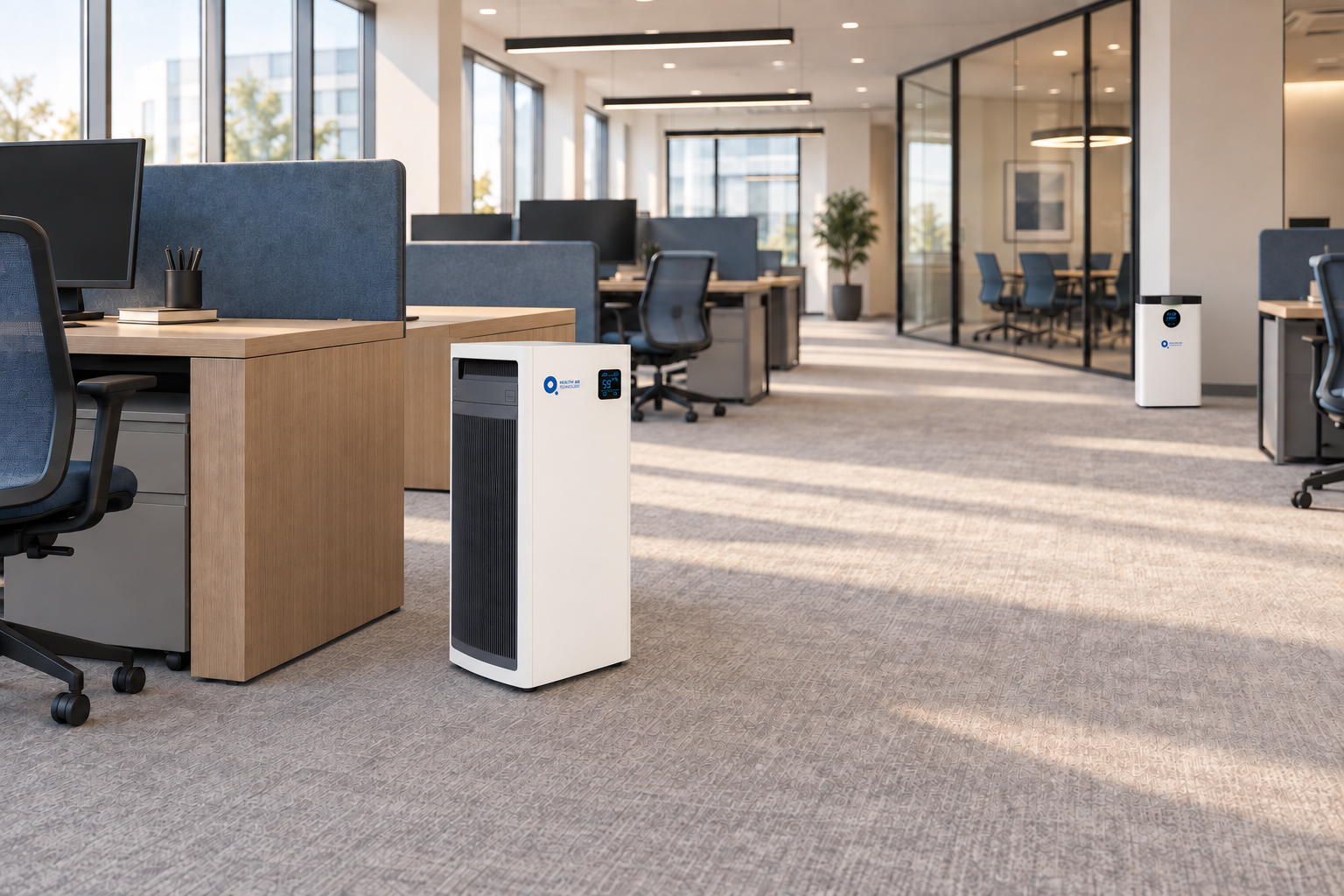
How can air purification improve air quality in offices and co-working spaces?
Key points Offices and co-working spaces often contain a mixed pollutant profile: outdoor particles, indoor dust, VOCs, bioaerosols,…

What a UK study reveals about indoor air triggers in asthma and COPD
Key points A UK mixed-methods study (Holt et al., Indoor Air) surveyed 332 people with asthma or COPD…

How can schools, universities and training centres use air cleaning effectively?
Key points Air cleaning can help reduce airborne particles in classrooms, lecture rooms, libraries, training rooms and shared…